You’ll find ancient folk instruments all around the world. The best-known instruments were flutes, whistles, and ocarinas of clay. These instruments were often decorated with symbolic figures, and were generally stylized to resemble animals, metaphysical entities, or people.
There are whistles and ocarinas representing ocelots, iguanas, frogs, chameleons, crickets, turtles, parrots and a great number of other birds. These ancient instruments can generate extraordinary sounds depending on their shape and size
Nowadays you can still learn to make these wind instruments. The Mexican artist Osvaldo Padrón for example, has a broad experience as a teacher (both in Mexico and The Netherlands) and makes wind instruments that are rooted in the tradition of the pre-Hispanic culture of the Aztec in Mexico.
Like to make your own ceramic flute?
On November 11th & December 9th, 2017 Osvaldo organizes the workshop 'Ceramic Flutes' that will take place at Keramiek Atelier Patty Schilder, located in the heart of Amsterdam, The Netherlands. There are only a few places left, so be quick to sign up here.
I've just visited the European Ceramic Work Centre in Oisterwijk (The Netherlands) where I joined a guided tour.
The EKWC is an artist-in-residence centre and a centre of excellence where about 60 artists, designers and architects are annually welcomed to experiment with ceramics for a continuous or phased period of three months.
Currently there are staying 15 artists from all over the world. They all have their own individual room (including a bed, a bathroom, and desk) as well as their own spacious studio with the most advanced equipment to work in. And because the studios and workshops are 24/7 available it's possible for the artists to work as long and as late as they want.
The centre also offers the support of a team of specialists that gives a unique added value to the residency as 75% of the participants have no or little experience with ceramics.
In addition to all this Sundaymorning@ekwc also encourages its participants to conduct research in not only artistic and technical fields, but also in the area of presentation.
And last but not least the centre works together with art academies, the ceramic industry, several scientific research centres, museums and galleries in the form of special projects.
Interested?
You'll find more information on their website.
According to the Latin from which the word is derived, perfection is the finished state of something. Imperfect would therefore only mean that it’s just not finished yet. My work entails objects that might look like things that once were perfect (or nearly perfect), but have now entered a decrepit state. And that’s exactly what I aim for.
I see the strenght of color, or the lack of it, the worn surfaces, rough edges, oxidized details & fading texts or images, and from it I read the underlying story.
To say that my work samples the art of imperfection, would therefore be doing it injustice. It’s never solely about the objects, always also about the stories.
The National Museum of Ceramics, De Princessehof, in Leeuwarden (Netherlands) presents ceramics as the cultural memory of the 20th century. The exhibition 'The 20th century – mirroring time in ceramics' tells the story of the previous century through approximately 400 ceramic objects, ranging from avant-garde to mass-produced objects. The ceramic objects are complemented by objects from other fine and applied art disciplines, and include furniture, paintings, a jukebox and even an original caravan from 1960. There are also film footage and historical photographs, which locate the ceramic objects in time. The exhibition can be seen from 5 September 2015 until 3 July 2016. Ceramics Museum Princessehof, Grote Kerkstraat 11, 8911 DZ Leeuwarden
Ruth Duckworth (1919 -2009) was a brilliant Modernist sculptor whose work in clay and bronze included monumental sculptures and murals, as well as small-scale pieces.
Born in Hamburg, Germany, Ruth came to Liverpool in 1936 as a refugee from the Nazi regime to join her sister, and to study at the Liverpool School of Art. It was only after the war that she became really fascinated with ceramics and in 1956 she started studying pottery at the Central School of Art and Crafts.
In 1964 she accepted a one-year teaching appointment at the University of Chicago but continued in this faculty post for 13 years and continued living
in the United States until her death in 2009.
Her work over the past five decades has contributed significantly to the development of Modernist style in sculpture, and her work reflects that radical way of working and thinking. Ruth shaped new ways of thinking about ceramics and brought an aesthetic rigour to her refined vessel forms, her figurative sculptures and installations. Most of her sculptures are inspired by the abstracted forms of nature. Many are shaped in stone, porcelain and bronze. Her most celebrated works however, have been in clay.
According to Emmanuel Cooper, a British ceramist and an editor of Ceramic Review, she was "a great original. Pioneering her own path within ceramics,
brilliantly exploring the idea of the figure, the vessel and the more abstract form.”
'Clouds Over Lake Michigan'
Her most famous large-scale work is 'Clouds Over Lake Michigan', a figurative depiction of the Lake Michigan watershed, which is on display at the Chicago Board Options Exchange Building. In the last decade she completed several monumental bronze sculptures for, among others, the campus of the Northeastern Illinois University in Chicago. Duckworth's work is represented in the Smithsonian American Art Museum's collection as well as major collections in the United States, Europe, and Japan.
Excerpts from 'Ruth Duckworth: A Life in Clay', the award winning documentary that traces the life of this prolific ceramic sculptor. Directed by Karen Carter.
Ooit functioneerden gevelstenen – evenals uithangborden – als 'reclame' voor de handel of nering die in of door de bewoner van het pand werd uitgeoefend, of ze verwezen naar de naam of de herkomst van de eigenaar of naar de stad waarmee de eigenaar bijvoorbeeld veel handel dreef. Maar ze deden, hoe dan ook, vooral goed dienst als adresaanduiding in een tijd dat men nog geen straatnaamborden of huisnummers kende.
Lang niet alle panden waren voorzien van zulke expliciete herkenningstekens. Het was dan ook een hele vooruitgang toen - tegen het einde van de 18e eeuw - het huisnummer werd ingevoerd. Op last van de Fransen (Napoleon) moest de bevolking geteld en geregistreerd worden. Om deze klus ietwat te vergemakkelijken werd een systeem van huisnummering bedacht en daar volgde vrijwel direct het aanbrengen van straatnaambordjes op. Overigens heeft het tot ver in de 19e eeuw geduurd, voordat àlle straten voorzien waren van huisnummers en naambordjes.
Hoewel er een gemeentelijk gebod op handhaving van de geveltekens gold, werd er in de afgelopen decennia openlijk in gehandeld. Gevelstenen raakten soms op drift. Ze werden bij sloop van een pand opgeslagen, om later elders weer te worden ingemetseld.
Oude gevelstenen zijn schaars goed geworden, maar gelukkig verschijnen er weer nieuwe gevelstenen in het straatbeeld. Dat is bijvoorbeeld het geval bij het woonhuis aan de Passeerdersstraat 3, een rijksmonument in Amsterdam. Daar moet volgens het stadsarchief vroeger een gevelsteen hebben gezeten, maar die is in de loop van de vorige eeuw verwijderd, ontvreemd of gewoon teloorgegaan. Het is onduidelijk welke afbeelding er op die steen vermeld stond, Was het een vos, een vogel en wat had die afbeelding te maken met wie er ooit woonde of werkte?
De Amsterdamse keramiste Cécile ter Borgh, heeft - in opdracht van de bewoners - een nieuwe gevelsteen gemaakt. Het is een prachtige steen geworden en zeker de moeite waard om in het echt te gaan bekijken.
Sempre Allegro (2015) - Gevelsteen gemaakt door Cécile ter Borgh in opdracht
van de familie Van der Veer voor het huis in de Passeerdersstraat 3 te Amsterdam.
Annual ceramics exhibition. Participating artists this year: Niqui Kommerkamp, Sylvie Enjalbert, Monica Sandell, Patty Schilder, Susan Melo, Cécile ter Borgh and Rudy Henriquez. This exhibition will be officially opened on Sunday, March 30th at 3:30 pm (doors open 2:00 pm).
Nu het jaar bijna om is, is dit misschien wel een mooi moment om m'n nieuwste beeld, Contemplation, te tonen. Contemplation maakt deel uit van 'n nieuwe serie 'Alzmums'.
Zo trof ik mijn moeder de laatste jaren vaak aan; kin op de borst en in gedachten verzonken. Haar armen stijf tegen zich aangedrukt.
Als je de buitenwereld niet meer herkent, keer je automatisch steeds vaker naar binnen; tot het moment dat je helemaal niet meer naar buiten komt. Maar toch, zelfs dán, reageer je nog op die aai over je hoofd of die kus op je wang.
Deze reizende expositie, beginnend in Frankrijk, toont de verrassende ontmoeting van 4 keramisten – uit vier verschillende landen – die 4 variaties op het thema “Naakte Huid” verbeelden. Elk vanuit de eigen culturele achtergrond visie en verschillende technieken.
Hun individuele reizen komen op een centraal punt samen; een vorm die ze 'Naked Skin' hebben genoemd. De klei wordt niet geglazuurd, in een enkel geval wordt er met oxiden of pigmenten gewerkt. Elke kunstenares toont haar eigen visie op 'Naked Skin'.
In de Elqui Vallei in Chili maakt Susan Melo gebruik van oude technieken en authentieke Zuid-Amerikaanse symboliek, waaronder cosmologische symbolen uit de Andes. Zij bedacht het plan om samen met 3 Europese keramisten te exposeren met de 'Naked Skin'-techniek als verbindend thema.
De in Frankrijk woonachtige Sylvie Enjalbert, creëert uit rollen klei, prachtige oude klassieke vormen; vloeiend, aaibaar en sensueel. Haar werk is tijdloos; het is een bijzondere mengeling tussen zowel klassiek als modern.
In Amsterdam werkt Patty Schilder vanuit het thema van het samensmelten van verschillende culturen en de onderlinge relaties tussen die culturen. De kleuren en texturen van de schilden en wandvazen verraden haar fascinatie met het erosieproces en zijn het resultaat van evenwicht tussen toeval en controle in combinatie met het vuur.
De beelden van de Zweedse Monica Sandell belichamen de taal van emoties, inspirerende universele gedachten en gevoelens. De beelden zijn ongeglazuurd waardoor ze benaderbaar en aaibaar worden; hier is de aanraking minstens zo belangrijk als de vorm.
Onafhankelijk van elkaar, zochten deze vier kunstenaars exact hetzelfde: hun eigen reactie op 'Naked Skin'.
Expositie Naked Skin / Piel Desnuda
Van 5 oktober tot 3 november 2013 bij Centre Céramique Giroussens, Tarn, Frankrijk.
Van 10 november tot 8 december 2013 bij Galerie Stam, Amsterdam, The Netherlands.
In Keramiekcentrum Tiendschuur in Tegelen loopt nog tot 22 september 2013 de expositie "Young Clay"; vernieuwend eigenzinnig werk van Engelse keramisten.
Los van deze expositie is ook de vaste collectie van de Tiendschuur de moeite waard. Het oudste keramische werk uit de collectie stamt uit ca 100 AD, het jongste werk is van hedendaagse Europese keramisten. Meer informatie vind je hier
Adres:
Keramiekcentrum Tiendschuur Tegelen
Kasteellaan 8
5932 AG Tegelen
Openingstijden:
Dinsdag t/m zaterdag van 14.00 - 17.00 uur
Zondag van 11.00 - 17.00 uur
Van 5 t/m 14 oktober organiseert Olea Art & Design weer een gevarieerde expositie aan het Funenpark 199.
Deelnemende kunstenaars zijn dit jaar Niek Bruynzeel en Gregorio Vallejo (schilderijen), Anne ten Broek en Niqui Kommerkamp (keramiek), Sabine Sloots (glass fusion) en Mark Croes (sieraden).
Open:
Vrijdag, zaterdag en zondag van 12:00 tot 18:00 uur en op andere dagen na telefonische afspraak (06 45280814).
Adres: Olea Art & Design, Funenpark 199, 1018 AK Amsterdam.
Het Funenpark bevindt zich in Amsterdam Centrum Oost, vlakbij molen De Gooijer. Op de Keerwal en op de Cruquiuskade zijn mogelijkheden tot parkeren (op zondag gratis).
De afgelopen weken ben ik druk bezig geweest met het maken van boekjes. Het resultaat is een prachtige combinatie van keramiek, handgeschept papier en ongebleekt katoen. Ik ben er zó tevreden over, dat er zeer waarschijnlijk meer van zullen volgen.
Nou ja, kijk zelf maar:
Ceramic books with signatures of handmade paper. Size: 6.3 x 4.3 X 1.2 inches
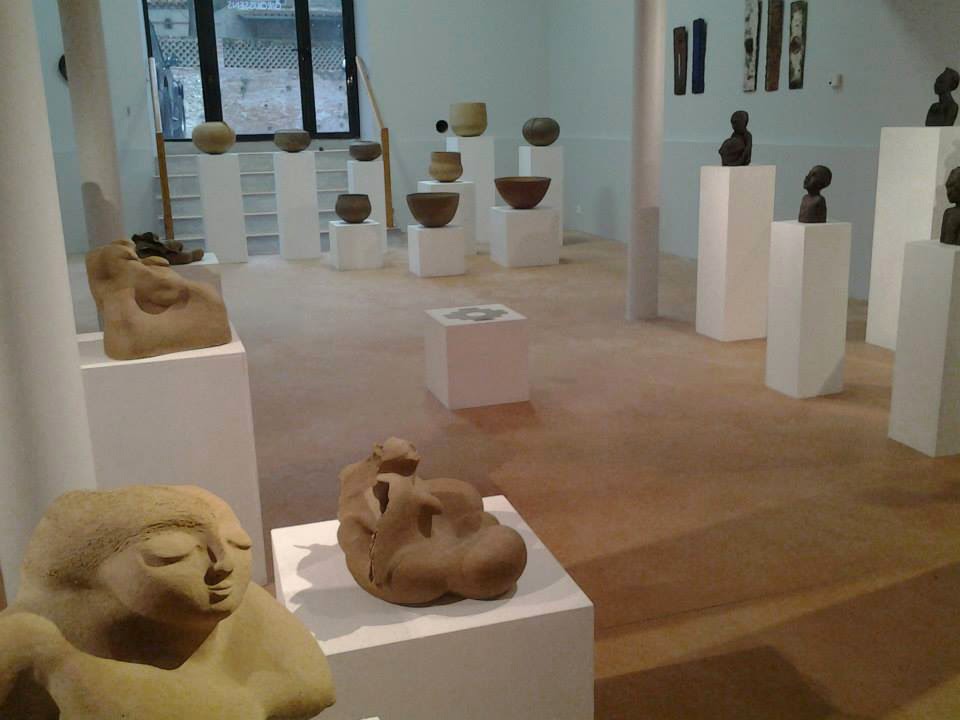
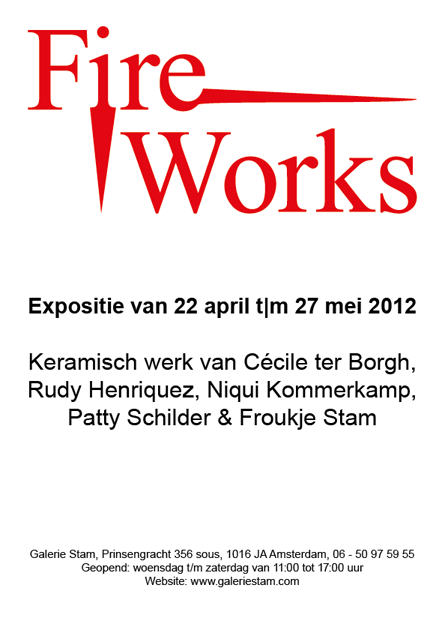
Ceramics by Cécile ter Borgh, Niqui Kommerkamp, Patty Schilder, Rudy Henriquez & Froukje Stam. This exhibition will be officially opened on Sunday April 22nd at 4 pm (doors open at 2 pm)